
Read the Walker County Owner of Record Card
The Walker County Board of Assessors' QPublic card is where an owner lookup usually begins. Its owner field names the party carried on the assessment roll. Separate mailing and physical address fields guard against a common mix-up. The card also ties that name to a parcel ID, taxing district, acreage, property class, and sales history. It adds the assessed value as well. Copy the whole set. A name alone can point to the wrong land. That risk grows without the exact parcel ID or situs address.
| QPublic owner | The person, estate, trust, or entity carried on the assessment roll |
|---|---|
| Mailing address | The destination used for assessment and tax correspondence |
| Physical address | The situs of the Walker County parcel, which may differ from the mailing address |
| Parcel ID | The exact identifier used to reconcile the card, tax account, map, and deed references |
| Sale entry | A lead to a transfer date and price, not a substitute for the recorded instrument |
| Deed evidence | The latest recorded instrument that states the grantee and how title was vested |
The owner of record is not always the person living there. A mailing address may sit outside Georgia. Someone other than the owner may have paid the tax bill. Treat the card as a current administrative snapshot. Then treat the deed as the recorded evidence of ownership.
Walker County's QPublic Fields Need to Stay Together
An official Walker County sample explains why copying only the displayed owner can mislead. Mailing address, physical address, taxing district, acreage, class, sales, and assessed value sit in separate fields. The card even carries its own creation and upload context. Those date clues matter when a deed was recorded recently, since the assessor roll and the recorded index are separate systems with separate update cycles.
The Walker County QPublic entry point opens the assessor search and parcel map. Search the address first, then copy the identifier exactly, including letters, zeroes, or punctuation. Walker County property records include both a plain numeric parcel, 1031069, and deed references such as 0280-099C. The county publishes no normalization guide, so silent reformatting is a poor shortcut.
A Walker Tax Card Is Not the Current Deed
Three records can seem to answer one ownership question while each answers a different one. QPublic names the assessment-roll owner. The Tax Commissioner's system tracks the account and billing record. The Clerk of Superior Court records the deed. That deed shows who transferred an interest. A paid bill proves payment, not title. And an assessor label may lag behind a just-recorded conveyance.
Use two dated sources. Compare the current QPublic card with the newest Walker County deed image before treating an owner name as confirmed.
The distinction matters most after a closing, an estate transfer, a survivorship event, or a corrective deed. Match parcels by reference and legal description, never by a similar person or company name alone.
See the Walker Parcel Card Layout Before Searching
The official assessor route appears in the Walker County search image below. It shows the interface a visitor will meet before entering an address or owner name.
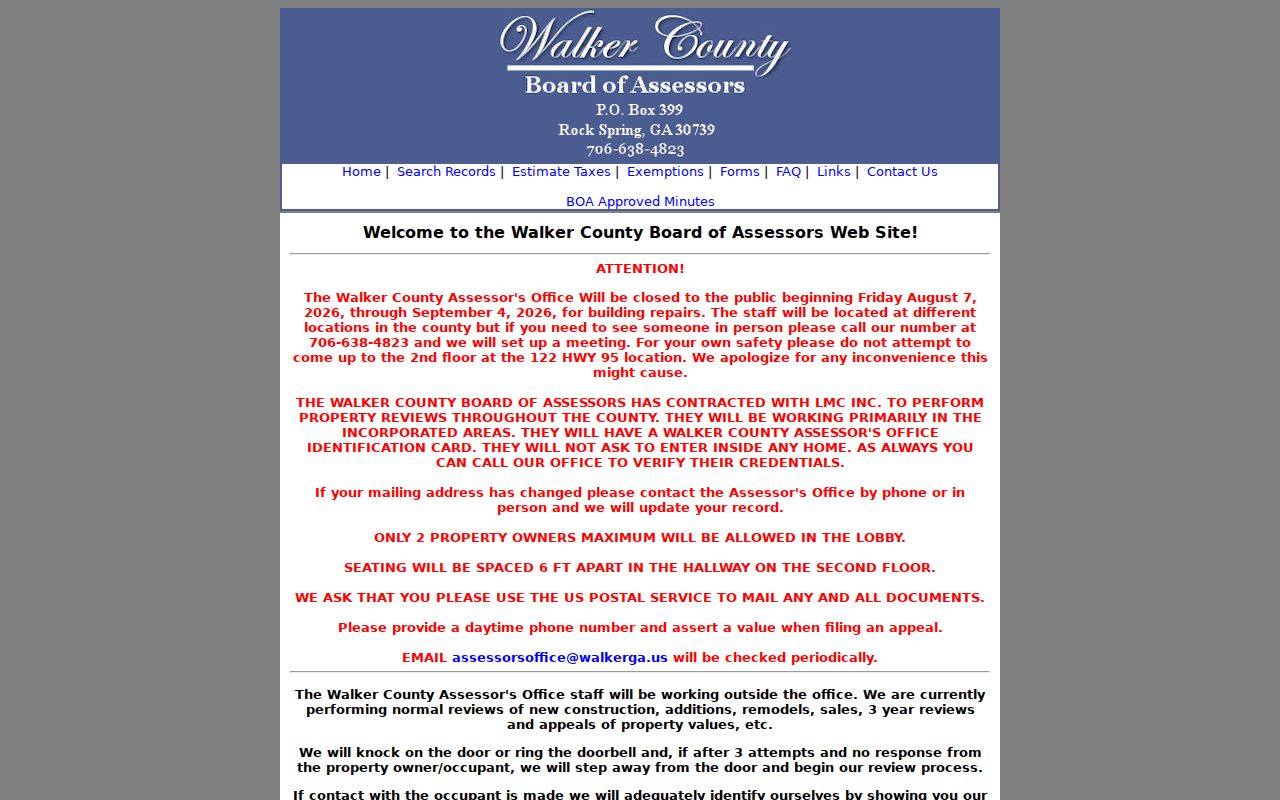
Once a result opens, keep the parcel identity beside the owner field. That keeps the later deed comparison tied to the same land.
Verify Who Owns a Walker County Parcel Now
Work from the current assessment entry toward the latest recorded conveyance. Keep the address, parcel ID, legal description, and recording reference together throughout. If an online page is blocked or unclear, use the office channel rather than treating a failed web search as a conclusion.
- Search the Walker County Board of Assessors/QPublic by physical address and record the exact parcel ID and current owner label.
- Search the GSCCCA Real Estate Name Search with Walker County selected, then open the newest plausible deed and compare its legal description.
- Read the grantee and vesting language, recording date and time, book/page, return address, and parcel references from the instrument itself.
- For a Georgia company, check the Secretary of State business record for entity status and registered agent, while remembering that the business filing does not prove title.
- Owner of record
- The party an official administrative or recorded source currently identifies as owner.
- Vesting
- The deed language describing who takes title and the form in which the interest is held.
- Tenancy
- The relationship among multiple title holders, including survivorship language when the deed supplies it.
- Registered agent
- The Georgia business filing contact for an entity, not necessarily the landowner as an individual.
Read Vesting From the Walker County Instrument
The deed image supplies details no owner label can. A Walker County quitclaim-deed sample recorded in 2024 lists grantor and grantee. Prepared-by and return-to details, book and page, recording time, transfer-tax display, multiple map and parcel references, and a metes-and-bounds legal description also appear. It also contains survivorship wording. Those details show how an interest passed, but a quitclaim deed guarantees nothing about title. Match the deed's land description and parcel references against the QPublic result. A shared surname is too weak. Subdivision, recombination, annexation, and mapping updates can change an APN. The legal description and any referenced plat identify the ground involved. The owner name can look stale. The recording timestamp and the assessor card's data date frame the possible update lag. Walker County publishes no fixed lag standard.
Identify a Walker County LLC, Trust, or Estate Owner
An entity name on the roll changes the verification path. Search the Georgia Corporations Division business search under exact and variant spellings. Its record can yield a control number, status, registered agent, and office information. That identifies the legal entity behind the displayed name. But a Secretary of State record does not convey land. The newest deed still controls the recorded vesting question. Trusts and estates need more care. A trust name may appear with no public detail about its beneficiaries. An estate label may hint that probate documents explain the transfer. Scan the deed for trustee, executor, administrator, survivorship, or heirs language. Use a legally public Probate Court file only to understand why title changed. A probate order or death record supports the chain; neither replaces a recorded deed.
When Walker County's Online Owner Result Fails
A blank or blocked result does not mean the owner of record is missing. Check spelling first. Try initials and entity name variants. Use the exact parcel number, too. Fort Oglethorpe mailing labels can point to land on either side of the Walker-Catoosa line. Confirm you are searching the right county. Protected-address programs such as Safe at Home and VoteSafe can also hide a mailing address. That limit deserves respect rather than a workaround.
For assessor help, visit the Walker County Board of Assessors at 122 Highway 95 in Rock Spring. For the recorded instrument, contact the Walker County Clerk of Superior Court at 103 South Duke Street in LaFayette. You can also call 706-638-1742. Ask about the current search procedure and the certified-copy fee instead of trusting an unverified amount. Older or displaced deed records may require a different stop. Try the county Records Center at 91 Industrial Drive in Chickamauga.
Contact the Walker County Current Owner Lawfully
A legitimate property communication starts with the public mailing address on the tax record. The reason could be a boundary question. It could be a purchase inquiry, an easement issue, or an estate matter. That address may be a post-office box, a business, or a destination outside Walker County. Treat it as a mailing point only. It is not proof of residence. Reconstructing a masked address from unrelated public systems is off limits.
Lawful use. Public owner information may support legitimate property research and communication. Never use it to stalk, harass, intimidate, or bypass an address-protection program.
Keep any written message respectful and specific. Identify the parcel and state the property reason for contact without publishing sensitive details. Is the owner of record an entity? The registered agent offers an official business contact route. For a title, boundary, or legal-notice issue, rely on a lawyer or title professional. A surveyor or formal service method works instead. An online mailing field alone is rarely sufficient.