
Sources for Walker County Former Owners
The Clerk of Superior Court keeps the deed records for Walker County. Those records anchor any search for Walker County former owners. GSCCCA puts many recorded instruments online. Deed books and probate minutes stretch the trail back further. Tax rolls and newspapers add names and dates. Yet only a recorded conveyance proves a past transfer, so the recorder's deed records remain the backbone of the work.
| Source | Years It Covers | Where Held | What It Shows |
|---|---|---|---|
| GSCCCA real-estate index | Central notice from 1990 | Online statewide index | Party, date, type, and book/page leads |
| Local deed books | Earlier recorded eras | Clerk and record collections | Earlier transfers and legal descriptions |
| Historical land and plat leads | Coverage varies | FamilySearch, DLG, library | Land lots, subdivisions, former place names |
| Court of Ordinary minutes | 1883 to 1906 catalog run | FamilySearch catalog | Estate orders tied to later deeds |
Start with the latest known transfer and work back, even when the goal is far older. Jumping to a surname in an old index invites errors.
Build a Walker County Ownership Timeline
A backwards timeline turns scattered former-owner records into a sequence anyone can check. Each row needs four things. Record the date, party direction, deed type, and exact locator. Do this for every transfer. The current owner's acquisition is row one, not the finish line.
| Transfer date | Grantor to grantee | Deed type | Book/page |
|---|---|---|---|
| Newest verified date | Prior owner to current grantee | As shown on the image | Exact citation |
| Earlier acquisition | Earlier grantor to later seller | Warranty, quitclaim, estate, or other | Exact citation |
| Older book era | Names from the reverse index | Read original text | Volume and page |
Confirm every row describes the same tract. A name match alone fails when land was split, combined, or carried under a changed parcel number.
Walker County Previous Owners in GSCCCA
Open the GSCCCA Real Estate Name Search and select Walker. Search the newest grantee first. Pull the deed image, read it, then search that deed's grantor as an earlier grantee. Try surname variants and entity spellings. Log the legal description before accepting a match.
The statewide index notice covers filings from January 1, 1990 through August 4, 2026. That span does not guarantee every Walker series is complete. County-owned images and the Clerk's official index control. Liens and plats live in their separate indexes. Search them there when they explain an ownership event, rather than treating them as deeds.
Note: A recent Walker filing may appear at the Clerk of Superior Court first. Statewide index displays can lag behind it.
See the Walker County Name Index
The GSCCCA real-estate search screen displays the controls for a former-owner lookup. Filter by party role, name, instrument class, county, and date.
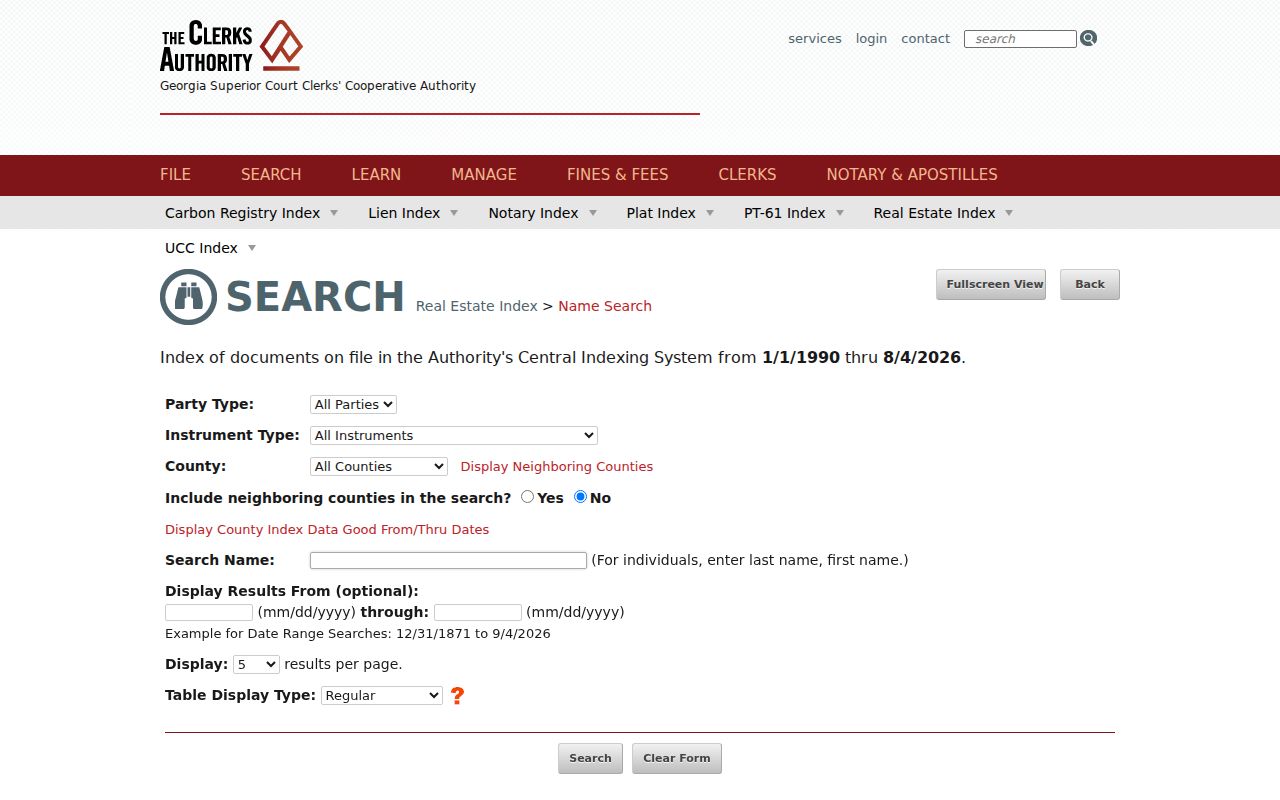
The form is only the doorway. The deed image and its matching legal description connect a result to the same Walker County parcel.
Reconstruct Walker County Prior Owners
The latest recorded deed names your first grantor. Treat the assessor's owner-of-record label as a lead only, and copy the legal description and book/page from the deed image before moving back.
- Find the newest deed and note the current grantee and prior grantor.
- Match the legal description, plat, and parcel clues to the land.
- Search the grantor as an earlier grantee to find that party's acquisition.
- Repeat, checking probate, foreclosure, corrective, and survivorship records.
- Continue in deed books when online coverage stops.
- Grantor / grantee
- The conveying party and receiving party named by the instrument.
- Chain of title
- The linked sequence of recorded interests affecting the land.
- Reverse index
- An index used to locate an acquisition through the receiving party.
- Legal description
- The land description that outlasts many address and parcel-number changes.
A Walker Quitclaim Can Break a Simple Story
An official county agenda packet contains a quitclaim recorded in 2024. It sits at Book 02327, pages 0847 through 0850. The instrument carries survivorship language, zero transfer tax, and four punctuated map or parcel references. That mix is not a standard sale.
Compare its description with the deeds on both sides. Estate distributions and survivorship events can all change names without an arm's-length purchase. Corrective filings and family transfers do the same. Preserve identifiers like 0280-099C exactly. Keep the leading zeroes, hyphens, and suffix letters intact whenever a parcel number is copied.
Probate Minutes Bridge Walker Deed Gaps
Death can remove a prior owner from the deed trail. An estate order may explain the next transfer. The FamilySearch catalog lists Walker County Court of Ordinary minutes from 1883 through 1906 on two indexed microfilm reels. Image availability there must be checked firsthand.
Search the estate name and date, locate the court authority, then return to the deed books for an administrator's, executor's, or heirs' deed. Marriage or divorce records may explain a name shift. Those records connect the story. The legal description and recorded conveyance keep it tied to the parcel.
Old Walker Owners May Sit Across County Lines
Walker County formed in 1833 from Murray and Cherokee territory. Later boundary changes drew in Dade, Chattooga, Whitfield, and Catoosa. Benton and Chattooga also appear in early county-seat history. LaFayette took that name in 1836. Searching only the modern county invites dead ends.
Use the current legal description to find the land lot and district. Then test predecessor jurisdictions and place names. The Georgia Headright and Bounty Land Records collection spans 1783 through 1909. It can supply names, acreage, and description clues from State Archives originals. Each candidate still needs a Walker-specific chain.
Walker Newspaper Notices Point Back to Deeds
Georgia Historic Newspapers lists 3,625 Walker County Messenger issues from 1880 through 2025. Search party names, sheriff sales, tax notices, and land-lot descriptions. A notice can narrow a date. It may identify the proceeding behind a transfer. Still, a newspaper item does not itself prove that title passed.
The LaFayette-Walker County Library collection page identifies Early Walker County Papers and Southeastern Native American Documents. Verify every clue against the deed or probate order.
Keep a Walker Former-Owner Research Log
A chain log works best this way. It separates what an index claims from what an image proves. For each candidate transfer, capture the search name, county, party type, date range, and result citation. Note the instrument type, book and page, and recording time. Also note the legal-description phrases that match the parcel. A source label and retrieval date belong on every entry too. When an image will not open, mark the item as a lead. Treat it as a lead, never as a verified fact in the Walker County property records.
Also log why ownership passed from one person to the next. A warranty deed usually reflects a sale. Consider a quitclaim, survivorship deed, foreclosure deed, or executor deed. Each can point to a different kind of event. A recorded lien or security deed does not create another former owner at all. Read releases and cancellations alongside the deed records they affect.
Dead links happen. Call or visit the Clerk. Do not patch the gap with a directory or a commercial data profile. If a library or archive holds the old record, ask for the collection title, reel or volume, page, and reproduction rule. Ask about the access restriction as well. That level of detail lets another researcher repeat your Walker County ownership history. They need not trust a bare name list.
How Far Walker Ownership History Reaches
Walker County ownership history reaches back well past the digital era. The statewide 1990 notice is the earliest online marker. Older records live in books and files at the local level.
How far you can trace a parcel depends on the record series. It also depends on how you reach it. The Clerk at 103 South Duke Street in LaFayette, reachable at 706-638-1742, holds local deed books. The office can explain current access.
More historical leads exist beyond the courthouse. The county Records Center sits at 91 Industrial Drive in Chickamauga. The LaFayette-Walker County Library, Georgia Archives, DLG, and FamilySearch all hold useful material. Together they help in tracing an owner of record across generations.
Lawful use. Research former owners for house history, estate work, and property diligence. Never use a past address trail to target or harass anyone.