
What Walker County Deed Records Reveal
Walker County deed records trace every transfer, easement, lien, and restriction placed on local land. They sit at the heart of any serious property search here. The Clerk of Superior Court maintains the controlling record for the county. A statewide index helps you find many filings fast. Older ownership questions reach further back, into deed books, microfilm, and library archives. Start with a party name or a deed reference. Then follow the instrument image and the legal description rather than trusting a tax-roll label alone. Each source plays its own part in rebuilding a parcel's paper path.
| Deed Type | What It Does | Common Use |
|---|---|---|
| Warranty deed | Conveys the stated interest with deed covenants | Conventional property transfer |
| Quitclaim deed | Conveys whatever interest the grantor has | Family, survivorship, or title cleanup |
| Security deed | Secures a debt against real property | Loan and later satisfaction trail |
| Executor or administrator deed | Transfers property through estate authority | Probate-related transfer |
| Tax deed | Records a transfer tied to a tax sale | Delinquent-tax proceeding |
Read the instrument type before assuming a name marks a former or present owner. A security deed or a lien burdens land. It does not convey it the way a warranty deed would. One 2024 Walker County sample shows why this care matters. It is a quitclaim deed with survivorship language, four map or parcel references, and no transfer tax at all. Treat that combination as an ordinary market sale and you will misread the parcel's history. You would err without ever opening the deed itself.
Search Walker County Deeds in the State Index
The GSCCCA Real Estate Name Search is the fastest online route into the deed record. Limit the county to Walker. Type the party name, and tighten the date range when you know it. The index notice states coverage begins January 1, 1990. That statewide claim does not guarantee every Walker volume is complete from that day forward. If a web result ever conflicts with the local record, the Clerk's own index controls.
| Search control | How it helps | Walker County caution |
|---|---|---|
| County | Limits results to Walker | Essential for common names |
| Search name | Accepts a person or entity lead | Try initials and name variants |
| Party type | Separates grantor and grantee roles | Search both when the role is unclear |
| Instrument type | Narrows the filing class | Do not confuse a lien with a deed |
| Date range | Reduces a long result set | Leave wider for uncertain dates |
Before opening any image, log the party spelling, the instrument type, the recording date, and the book and page. A tidy list of results keeps a long search from turning into guesswork. Note: A recent filing may appear at the Clerk before every statewide index view has caught up.
A Walker County Quitclaim Deed in Detail
An official county agenda packet offers a genuine instrument to study. The quitclaim was recorded March 18, 2024 at 4:43 p.m. It sits in Book 02327, pages 0847 through 0850. Carter Brown appears as Clerk. The deed carries prepared-by and return-to details, survivorship language, and map or parcel references. Those references are 0280-099, 0280-099C, 0078-020, and 0078-020A. Those punctuated identifiers deserve respect. Copy leading zeroes and suffix letters exactly as the record shows them. Then compare the metes-and-bounds description and any plat citation. The zero-dollar transfer-tax display is a transaction clue. It is not proof of no consideration or of market value. Close reading of this kind is what separates a recorded transfer from a mere row in an index.
Book and Page Opens the Exact Walker Instrument
A parcel card, a prior deed, a court filing, or a county agenda can hand you a citation. Use the GSCCCA Book/Page Search with Walker County selected, keeping the book and page formatting intact. This route skips past false matches among similarly named people and lands directly on the cited record.
- Grantor
- The party conveying the stated interest.
- Grantee
- The party receiving the stated interest.
- Chain of title
- The linked sequence of instruments affecting the same land.
- Book/page
- The recorded location assigned to an instrument.
Keep two identifiers straight. An instrument number and book/page locate a record; a parcel ID serves assessment and mapping. Walker's subdivision property-search mode does not appear on the GSCCCA participation list, so never assume a QPublic parcel number fits that search.
Walk the Walker County Grantor-Grantee Trail
Rebuilding ownership means walking backward. Start from the newest deed you can verify. Then move toward older transfers, step by step. The owner shown on QPublic is a lead, nothing more. Take the current grantee's spelling, then find the acquisition instrument. Search the grantor's name for the earlier deed. That is the deed by which the same land was acquired. One link at a time, the chain of title takes shape.
- Find the newest instrument and record its grantee, grantor, date, book/page, and legal description.
- Confirm that its land description and parcel references match the property under study.
- Search that grantor as an earlier grantee and locate the prior acquisition deed.
- Repeat while checking corrective deeds, probate, foreclosure, survivorship, and name changes.
- Move to local deed books and archival leads when the online index ends.
Quitclaims, executor deeds, heirs' deeds, foreclosures, and survivorship events can all snap a tidy buyer-to-seller pattern. Legal descriptions hold the trail together, because parcel numbers change after a split, recombination, annexation, or mapping update. The former owners guide follows this historical route in full.
Free Viewing and Paid Walker Deed Access
GSCCCA runs its search service on accounts. A regular account costs $14.95 per calendar month. Premium access runs $29.95 per month per user. A $5 single-use activation lasts four hours. Viewing images is free; printing costs $0.50 per page. Premium adds address, daily, map, sales, related-record, report, and combined index/image options. For an official or certified copy, the Clerk remains the source.
| Route | Best use | Cost or limit |
|---|---|---|
| GSCCCA image | Inspect a located filing | View free; print $0.50/page |
| Regular account | Recurring index research | $14.95/calendar month |
| Single use | Short focused session | $5 for four hours |
| Clerk counter | Official index and copy procedure | Confirm current local fee |
The Clerk publishes no certified-copy fee schedule or mail procedure for Walker County deeds online. Contact the office before sending payment or a records request.
See the Walker Deed Search Screen
The official GSCCCA name-search page displays the county, party, instrument, name, date, and results controls you will use to begin a Walker County deed records search.
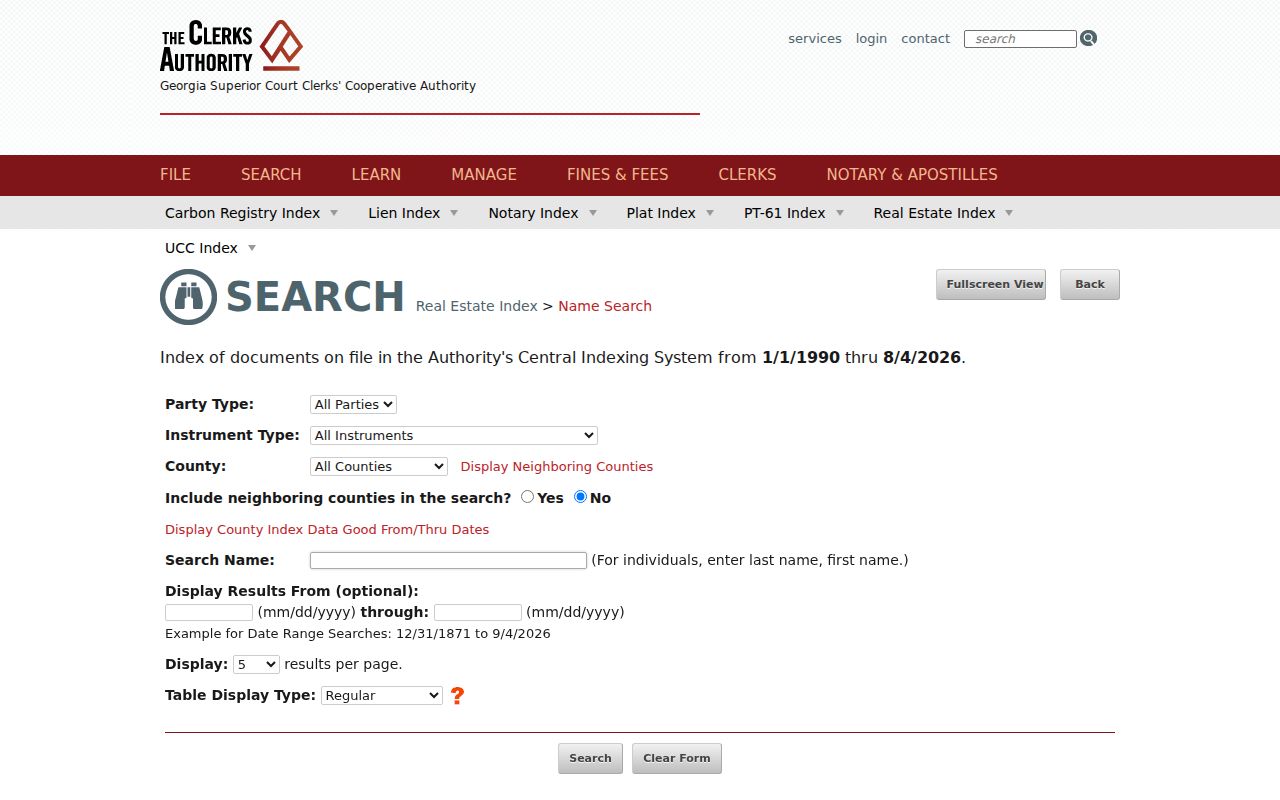
Set the county and the party role before reviewing any matches. The result still must tie back to the right legal description.
Older Walker Deed Books Cross Former Boundaries
Walker County was cut from Murray and Cherokee lands in 1833, and its borders shifted afterward in deals involving Dade, Chattooga, Whitfield, and Catoosa. That history matters for deed records. A parcel sitting in Walker today may have been recorded under a different county or an older place name. So widen the search. Pair the land lot and district with party names and the legal description. Benton, Chattooga, and LaFayette all hold context worth checking.
The FamilySearch catalog lists land records and general indexes reaching into the nineteenth century, though image availability there must be confirmed before you plan around it. Other routes exist too. The LaFayette-Walker County Library genealogy area, Georgia Archives, Digital Library of Georgia, the Clerk, and the county Records Center at 91 Industrial Drive in Chickamauga can all hold pieces of the chain. Old newspaper notices sometimes surface a sale or an estate name. Still, the deed or the court order remains the true verification source.
Note: Online coverage does not exhaust Walker County deed records; tracing older owners of record may take local books, microfilm, and archival finding aids.
Request a Missing Walker Recording Record
For an index gap, rejected document log, fee schedule, or records-center inventory that is not published, use Walker County's Open Records instructions. A precise request names the party, parcel or book/page, instrument class, date range, and desired format. It can be emailed to openrecords@walkerso.com or mailed to 101 South Duke Street, LaFayette, GA 30728, though the Clerk may route deed copies through its own court-record procedure.
Georgia agencies generally respond within three business days by producing available records or explaining timing and cost. Walker states that the first 15 minutes of staff search time are free and ordinary copies are generally $0.10 per page unless another law applies. Ask for an estimate and electronic delivery. The agency need not create a custom title chain or answer a research question.
Obtain a Walker County Deed Copy
Use the statewide image for everyday work. When a document will be relied on formally, ask the Walker County Clerk of Superior Court for the current plain-copy and certified-copy procedure instead. The record center sits at 103 South Duke Street, LaFayette, GA 30728, and the office phone is 706-638-1742. Call before mailing payment, because the local copy fee and certified markup are not published. A short call prevents a returned envelope.
Whether at the counter or through an approved request route, supply the essentials: Walker County, instrument type, recording date, party names, and book and page. Say plainly whether you need an ordinary image or a certification. Only a deed-card citation in hand? Start with the book and page search. Liens and plats live in their separate GSCCCA indexes, and you should pull later releases, cancellations, or replacement plats to complete the picture.
Recorded, not guaranteed. A Walker County index entry shows that an instrument was filed; it is not a title opinion, and unrecorded interests may exist.